Average Reviews:

(More customer reviews)FUD - Fear, uncertainty, doubt.
According to Wikipedia, "the term originated to describe disinformation tactics in the computer hardware industry and has since been used more broadly. FUD is a manifestation of the appeal to fear."
Still Wikipedia, quoting Eric S. Raymond: "The idea, of course, was to persuade buyers to go with safe [...] gear rather than with competitors' equipment. This implicit coercion was traditionally accomplished by promising that Good Things would happen to people who stuck with [...], but Dark Shadows loomed over the future of competitors' equipment [...]".
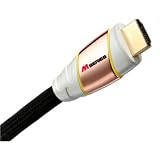
HDMI is all-digital for both sound and picture. As such, it either works or it doesn't and, when it doesn't work, you will know immediately. There's really nothing in-between. If a claim is made that the Monster is 'more reliable' or that it 'lasts longer', I can't see how such claim can be backed - does the hundred-dollar cable last 20 times longer than than the five-dollar cable? And, if it does, do we REALLY care that a cable supporting a standard that may be obsolete in 5 years COULD last for 100 years?
By the way, I do not challenge the claim of high quality for this cable. It appears to be well built. However, it is quality not needed and, in my view, not worth paying for. The way most of us use cables is: we plug them at the back of our electronic boxes and, if they work on 'day one' they are likely to work in the exact same fashion on day 1000 because they are not going to be subjected to any physical or thermal stress and the materials used to build them are not easily degradable. While 'quality' was important for analog cables where good quality made all the difference in the world, the digital wires either transmit the digits or they don't. If they do, they all work the same, the $1 HDMI cable gives you the exact same 'performance' the $100, gold-plated cable does.
The claims that seem to suggest that these expensive wires allow more Gigabytes of data to pass through and the implied suggestion that you would get a less bright image or a less crisp sound if you used a two-dollar cable are NOT true. The HDMI is a published standard and there is a minimum data throughput that must be supported. If it is, then the device is HDMI compliant and you will get everything that HDMI promises to deliver. If some cable exceeds the specified throughput, it's nice but it's irrelevant because no electronic component that's HDMI compliant would attempt to push more bytes through the wire than the standard specifies. If they did, they'd violate the specs and would not sell very well. If your electronic component had an HDMI port that called for an HDMI cable that exceeded the HDMI published standards, then it would no longer be called an HDMI port but a proprietary, non-standard solution.
The following are the HDMI 1.3 specs and ALL certified HDMI 1.3 cables (including the five-dollar wires and the Monster) are going to support them. Whatever 'extra' the M Series offers is useless because no HDMI-connected hardware component is going to ask for more.
Maximum signal bandwidth (MHz)340
Maximum TMDS bandwidth (Gbit/s)10.2
Maximum video bandwidth (Gbit/s) 8.16
Maximum audio bandwidth (Mbit/s) 36.86
Maximum Color Depth (bit/px)48
Maximum resolution over single link at 24-bit/px 2560
